
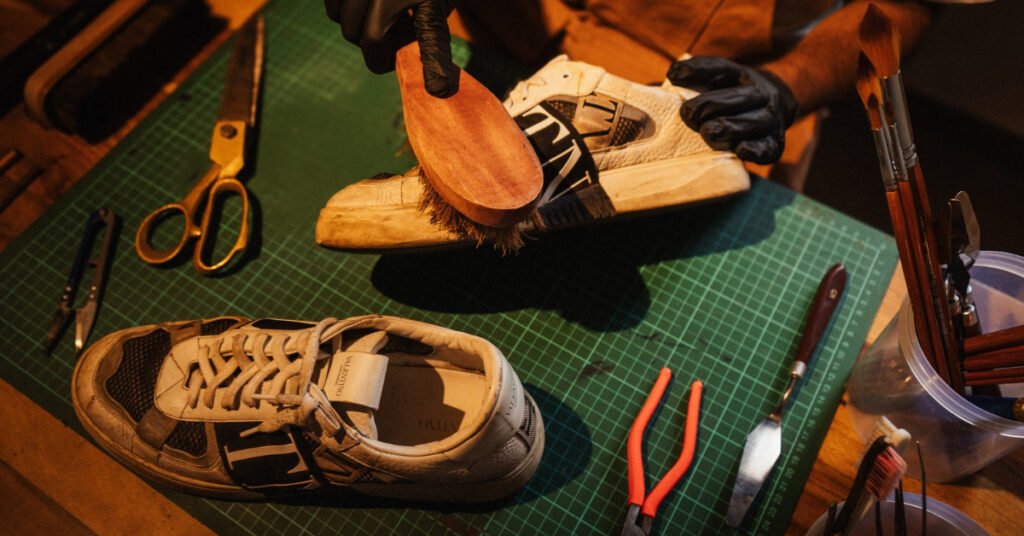
A favourite pair of leather shoes rarely fails all at once. The colour fades at the toe, a sole starts to lift, a stale smell settles in, and one day the leather cracks along a crease. Regular shoe cleaning slows most of this, and timely repairs stop small faults from turning into expensive ones. This guide explains what you can safely do at home, when to call a specialist, and what professional leather shoe care involves, so you can decide with confidence.
Quick Answer: How Can You Clean and Repair Leather Shoes?
For light dirt, brush off dust, wipe with a slightly damp soft cloth, condition the leather and let the shoes dry naturally. For detached soles, broken heels, cracked or torn leather, faded colour, or stubborn stains and odour, use a professional shoe repair service. The right treatment always depends on the shoe’s material and condition.
Why Do Leather Shoes Need Special Cleaning and Maintenance?
Leather is a natural material made of fibres that rely on oils to stay supple. Everyday wear, moisture, heat and dirt slowly strip those oils away, which is why shoes dry out, crease deeply and lose colour.
Cleaning mistakes can do as much harm as neglect. Household detergents, bleach and strong solvents can lift dye or dissolve the finish. Soaking can swell the leather and weaken glue and stitching.
Different leathers also behave differently. Finished leather, suede, nubuck and patent leather each need their own products and technique, so a method that suits one can ruin another. The Leather Laundry, an industry information site, advises in its care guide to use products made for leather, test them on a hidden spot first and avoid scrubbing stains hard.
Professional Shoe Cleaning vs. Regular Home Cleaning: What’s the Difference?
Home cleaning is perfectly adequate for light dust and fresh scuffs, and our step-by-step shoe cleaning guide covers the routine. Professional shoe cleaning earns its place when the problem runs deeper than the surface.
| Factor | Home Cleaning | Professional Shoe Cleaning |
| Cleaning method | Soft brush, lightly damp cloth, mild leather cleaner | Method chosen after assessing material, finish and condition |
| Stain treatment | Suits fresh, light marks; older stains risk spreading or lifting colour | Stain-specific treatment, including set-in marks |
| Leather conditioning | Off-the-shelf cream or conditioner | Conditioning matched to the leather type |
| Colour restoration | Matching polish or cream for minor scuffs | Colour matching and recolouring for faded or worn areas |
| Material-specific care | Depends on the owner’s product knowledge | Suede, nubuck, patent and finished leather handled differently |
| Best suited for | Routine upkeep and light dirt | Heavy soiling, odour, faded colour, valued or delicate pairs |
Not every minor mark needs a specialist. A quick wipe and a little conditioning are often enough; the table simply shows where each approach fits best.
What Does Professional Leather Shoe Dry Cleaning Include?
Leather shoe dry cleaning generally means cleaning with controlled, low-water methods and specialist products rather than a wash. A typical professional process runs through these stages:
- Assessment. The technician identifies the material and finish, and checks for cracks, loose stitching and sole or heel wear.
- Surface and deep cleaning. Dust and grime come off first, then ingrained dirt is treated with products suited to that leather.
- Insole and lining cleaning. Interiors collect sweat and dirt, so they need attention too.
- Stain treatment. We treat each mark individually instead of using one blanket product.
- Deodorising, and mould treatment where it appears.
- Conditioning and polishing to restore suppleness and shine.
- Protective finishing to help the leather resist everyday wear.
The Leather Laundry describes its work as professional cleaning, colouring, refinishing, deodorising and repairing for leather shoes, apparel and accessories. Material matters at every stage. Suede and nubuck need brushing and specialist cleaners rather than creams, patent leather needs gentle handling to protect its gloss, and finished leather tolerates conditioning and polish.
Common Shoe Problems That Require Professional Shoe Repair
Our shoe repair guide goes deeper on each fault; here is the short version.
Damaged or Detached Shoe Soles
A sole that peels at the toe or gapes along the edge usually needs re-bonding, re-stitching or full resoling. Walking on a loose sole strains the upper, so stop wearing the pair and have an expert assess it.
Broken Heels and Worn Heel Tips
Replacing a worn heel tip is a small job; waiting until it wears through can damage the heel itself. A loose or broken heel needs proper heel repair so it stays aligned and secure.
Cracked, Faded or Scratched Leather
Fine scratches can often be improved with cleaning, conditioning and matching colour. Deep cracks and heavy fading usually need filler, colour matching or recolouring, and results depend on how far the damage has gone.
Torn Leather, Open Seams and Stitching Damage
Open seams can be re-stitched, and a tear may need a patch from the inside. Early repair stops a small split from spreading.
Unpleasant Odour and Internal Dirt
Persistent odour usually sits in the insole and lining, where surface wiping never reaches. Deep cleaning and deodorising treat those areas.
| Problem | Typical treatment | When professional repair is needed |
| Lifting or detached sole | Re-bonding, stitching or resoling | As soon as it separates or the sole is worn thin |
| Broken heel or worn heel tip | Heel repair, heel-tip replacement | When the heel is loose or uneven, or the tip has worn through |
| Fine scratches, light fading | Cleaning, conditioning, matching polish | Home care usually suffices unless colour is patchy |
| Deep cracks, heavy fading | Filler, recolouring, refinishing | Once the leather has split or colour has worn off |
| Torn leather, open seams | Patchwork, re-stitching | Any tear or open seam that is growing |
| Odour, mould, internal dirt | Deep cleaning, deodorising | If odour returns after airing, or mould is visible |
Leather Shoe Repair Services: What Can Actually Be Restored?
Many problems are fixable, but not every damaged pair returns to its original condition. Deep cracking, thin worn leather and heavy damage have limits, and an honest assessment will say so.
The Leather Laundry’s shoe repair and restoration service covers sole repair, heel repair and colour restoration, alongside cleaning, refinishing and deodorising. Its technicians work under the supervision of founder Mallika Sharma, a certified professional leather care technician trained with LTT in the UK. For resoling, stitching or patchwork, or for materials such as suede and patent leather, send photos for an assessment first, so you know what can realistically be done before you commit.
How to Choose the Right Leather Shoe Repair Service
A good provider should:
- Know different leathers. Ask how they handle suede, patent and finished leather.
- Explain their cleaning method rather than claiming to do everything.
- Show their craftsmanship, ideally with real before-and-after examples of shoes like yours.
- Explain your assessment, pricing and what you cannot restore.
- Communicate clearly, including pickup and delivery if you cannot visit in person.
The Leather Laundry is one option for professional leather shoe cleaning and repair, and its FAQs answer common questions before you enquire.
How to Maintain Your Leather Shoes After Professional Cleaning
- Brush off dust and surface dirt after wearing.
- Condition the leather periodically with a product suited to its finish.
- Keep shoes out of direct sunlight and away from heat, which dry leather and speed up fading, as leather-care guidance notes.
- Store them somewhere cool, dry and ventilated, in a breathable bag rather than plastic.
- Use shoe trees where suitable to hold shape and absorb moisture.
- Rotate pairs, and deal with stains and damage early.
What NOT to Do When Cleaning or Repairing Leather Shoes
- Don’t dry wet shoes with a heater, hair dryer or in the sun. Let them dry naturally at room temperature.
- Don’t use bleach, household detergents or harsh solvents; they can strip dye and finish.
- Don’t machine-wash leather shoes.
- Don’t put creams or oils on suede or nubuck, or treat patent leather like ordinary leather.
- Don’t glue a lifting sole or torn seam yourself; adhesive residue can make a proper repair harder.
- Don’t store shoes in plastic bags or airtight boxes.
- Don’t ignore small cracks, loose stitches or worn heel tips.
- Don’t trust any service that promises “like new” without seeing the shoe.
Give Your Favourite Shoes a Second Life with The Leather Laundry
Regular shoe cleaning, a timely repair and sensible storage can keep leather shoes in use for years. If your pair needs more than a wipe, whether that is a lifting sole, a worn heel, faded colour or stubborn odour, The Leather Laundry can assess it and tell you what is realistically restorable. Browse its full range of leather care services, then send clear photos through the website enquiry form or WhatsApp (add WhatsApp link) for an assessment and quote.