
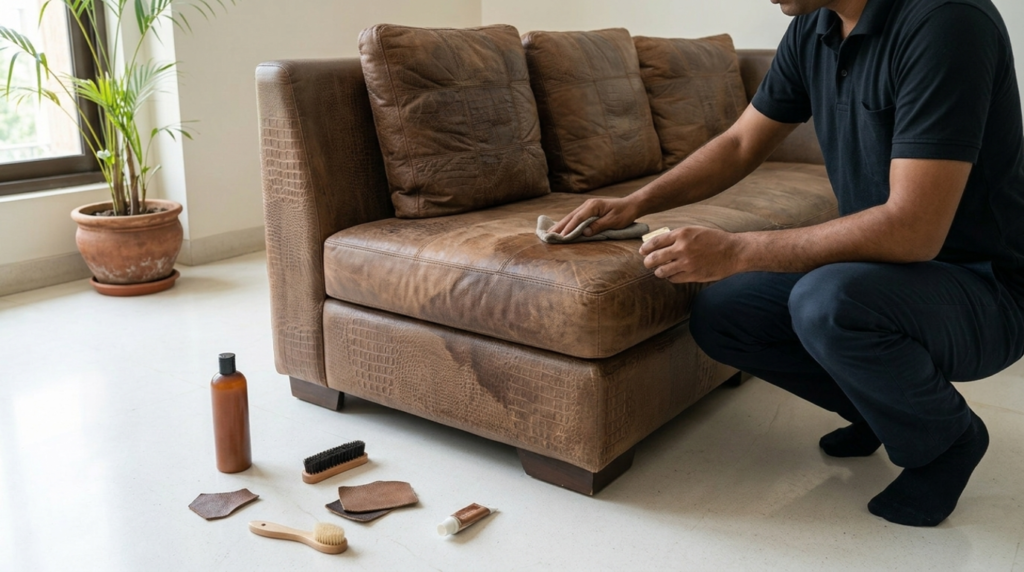
A leather sofa usually shows its age in small ways: a faint crack on the armrest, a pet scratch, a seat that looks dull where everyone sits. Then the surface starts flaking, and it feels like the end for your sofa.
This guide covers what you can fix, what you can try yourself, and when professional leather sofa repair beats replacement.
Can a Damaged Leather Sofa Be Repaired?
Yes, if the damage is in the surface or finish and the sofa’s structure is sound. Most leather sofas have a thin protective finish that a technician can fill, recolor and reseal when it wears or cracks.
Repair, restore or replace: how to decide
| Choose this | When |
| Repair | Damage is limited to one or two areas, such as a crack, scratch, tear or small peeling patch. The rest of the leather is still supple. |
| Restoration | The leather is faded, dry or worn across the whole sofa, but still strong. It needs cleaning, recolouring and a fresh protective coat. |
| Partial replacement | One part has failed, such as an armrest, a cushion cover or a single panel. Matching leather can be used to replace just that section. |
| Replace the sofa | The leather is breaking down everywhere, the frame is cracked or wobbly, or the foam has collapsed and the sofa is no longer comfortable. |
Common Leather Sofa Problems and How to Fix Them
Test any product on a hidden spot first, such as under a cushion or on the back. Let it dry fully and check the colour and feel before you start.
How to Repair Cracked Leather Sofa Surfaces
Cracks appear when leather dries out or its finish wears down from sunlight, body oils and friction.
You will need: a leather-safe cleaner, a soft cloth, fine-grit sandpaper, flexible leather filler, a small spatula or palette knife, matching leather colour, and a sealant.
- Clean the area with a leather-safe cleaner and a soft cloth. Let it dry completely.
- Lightly sand the edges of the crack with fine-grit sandpaper so the filler can grip. Wipe away the dust.
- Apply filler in thin layers with a spatula, pressing it into the crack. Let each layer dry as the product instructs before adding the next.
- Smooth and texture the dried filler so it sits level with the surrounding grain.
- Apply colour in thin coats, drying between each, then seal.
DIY limit: stiff or thick filler cracks again, and a colour that is slightly off shows straight away. Fine cracks are manageable at home. Deep or widespread cracks need a professional.
How to Fix Tears, Cuts and Holes in Leather Sofas
Tears usually come from sharp objects, pet claws or stress at seams.
You will need: scissors, a leather-safe adhesive, a canvas or leather backing patch, flexible filler, matching colour and sealant.
- Trim loose threads and clean around the tear.
- Cut a patch slightly larger than the tear and slide it underneath, flat and smooth.
- Glue the edges of the tear down onto the patch and press them together. Leave to set as the adhesive instructs.
- Fill the seam with thin layers of filler until it is level.
- Recolour and seal.
DIY limit: a repair without support underneath often reopens. Tears at seams, seat edges or in a high-use cushion may need reinforcement or a replacement panel.
How to Fix Scratches and Scuff Marks on Leather Sofas
You will need: a soft cloth, leather conditioner or balm, and, for deeper scratches, filler and matching colour.
- Check the leather type. Aniline leather can darken when treated, so test a hidden spot first.
- Clean the scratch gently with a soft, slightly damp cloth and let it dry.
- Work in a little conditioner or balm with your fingertip, using small circular motions. Light scratches on coated leather often fade.
- Fill and recolour if the scratch is deep or has removed colour, then seal.
DIY limit: balms suit light marks. Deeper scratches need filling and a proper colour match.
What Is Involved in Professional Leather Sofa Restoration?
- Inspection and assessment: the technician identifies the leather type, finish and depth of damage.
- Cleaning and preparation: the technician removes dirt, oils and residue so repairs bond properly.
- Repair: the technician fills, patches and levels cracks, tears and damaged areas.
- Colour matching and recolouring: the technician applies colour in thin layers for an even tone.
- Conditioning and protection: a protective coating helps resist wear and spills.
- Final inspection: the technician checks colour, texture and feel in good light.
Results vary with leather type and condition, and not every sofa can return to a like-new finish.
People often mix up these terms, but they solve different problems:
- Cleaning removes dirt and oils. It does not fix damage.
- Conditioning restores moisture and softness but cannot repair existing cracks.
- Repair treats specific damage such as cracks, tears or peeling.
- Restoration is the full process: cleaning, repair, recolouring and protection.
How Much Does Leather Sofa Repair Cost?
The cost of leather sofa repair depends on the damage, not a flat rate. As a rough market guide, professional leather sofa cleaning and repair in India. Cleaning and conditioning sit at the lower end, extensive recolouring or structural restoration at the higher end. Quotes vary by provider and sofa.
At The Leather Laundry, you send clear photos on WhatsApp (+91 1122795768) and receive a no-obligation quote within 30 minutes to 24 hours. We share a job sheet for your approval before any work begins.
How to Maintain Your Leather Sofa After Repair
- Dust and wipe regularly with a soft cloth and a leather-safe cleaner.
- Avoid harsh chemicals and alcohol wipes.
- Keep the sofa away from long, direct sunlight and heaters.
- Condition the leather when appropriate for its finish.
- Fix small scratches early, and follow your technician’s aftercare advice.
Give Your Leather Sofa a New Lease of Life with Professional Restoration
Cracked, torn or peeling leather doesn’t always mean you must replace your sofa. The best first step is a proper assessment. The Leather Laundry handles leather sofa cleaning, crack sealing, tear repair, recolouring and protective finishing, with home-visit service in Delhi NCR, Mumbai and Bangalore.
Have a damaged leather sofa? Contact The Leather Laundry for a consultation or repair enquiry.